
What Percent of Large Cities Have Avoided Natural Disasters so far in 2026?
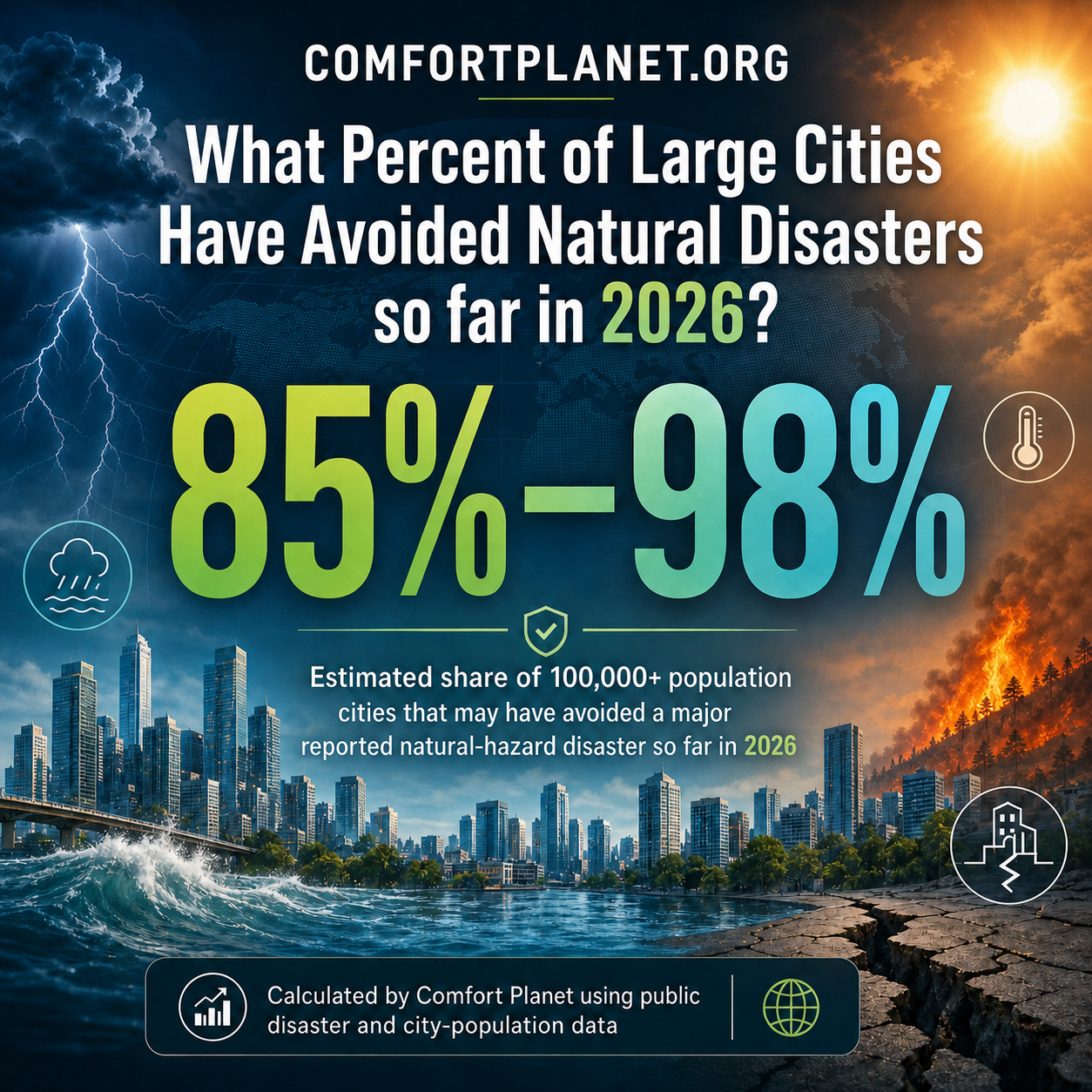
Comfort Planet estimates that about 85% to 98% of cities with 100,000 or more people may not have been directly associated with a major reported natural-hazard disaster so far in 2026.
That number is not an official global statistic. It is a Comfort Planet calculation based on public disaster data, United Nations city-population data, and transparent assumptions. The reason we need an estimate is simple: there is no public live database that cleanly tells us which every city above 100,000 people has or has not experienced a natural disaster in 2026.
Global disaster databases track major events. Global population datasets track cities. But the two are not joined together in a simple city-by-city table. So instead of pretending an exact number exists, Comfort Planet calculated a reasonable range using available data.
The short answer
The best current estimate is:
About 85% to 98% of cities with 100,000+ people may have avoided a major reported natural-hazard disaster so far in 2026.
This estimate does not mean those cities are risk-free. It only means they may not have been directly tied to a major disaster record so far this year.
Why there is no exact official percentage
EM-DAT, the International Disaster Database, is one of the most important global sources for disaster data. Our World in Data explains that its natural-disaster event chart is based on EM-DAT and includes hazards such as droughts, earthquakes, extreme temperatures, floods, mass movements, storms, volcanic activity, and wildfires. The Our World in Data page was last updated on April 30, 2026.
But EM-DAT is not a city-by-city tracker. EM-DAT says it records disaster losses at the country level for events meeting major-disaster criteria. Those criteria include at least 10 deaths, at least 100 affected people, a declaration of a state of emergency, or a call for international assistance.
That matters because one disaster can affect one city, several cities, rural areas, or an entire region. A flood may affect multiple towns. A storm may cross several provinces. A drought may cover a large region. A wildfire may damage one neighborhood but not an entire city. Because of that, the exact question — “What percentage of 100,000+ population cities have had zero natural disasters in 2026?” — requires geospatial mapping that is not available as a simple public number.
Step 1: Estimate the number of large cities
The United Nations’ World’s Cities in 2025 data booklet reports more than 12,000 cities worldwide with at least 50,000 people. A useful city-size breakdown includes:
- 33 megacities with more than 10 million people
- 49 cities with 5 million to 10 million people
- 429 cities with 1 million to 5 million people
- 1,822 cities with 250,000 to 1 million people
- 9,807 very small cities below 250,000 people, while still meeting the UN city threshold
From those categories, we can calculate the number of cities with at least 250,000 people:
33 + 49 + 429 + 1,822 = 2,333 cities
The number of cities with at least 100,000 people is larger than 2,333 because it includes many cities between 100,000 and 250,000 people. For this Comfort Planet estimate, we use a working range of 4,000 to 5,000 cities with 100,000+ people.
This 4,000 to 5,000 range is an estimate, not an official UN category in the cited city-size table. It is used as a practical denominator because the public summary separates 250,000+ cities clearly but does not provide a clean 100,000+ category in the same breakdown.
Step 2: Estimate the disaster pace for 2026
The latest complete-year global disaster benchmark is 2025. According to the 2025 EM-DAT disaster report summarized by PreventionWeb, EM-DAT recorded 358 natural hazard-related disasters in 2025. Those events caused 16,607 deaths, affected 110.2 million people, and caused about US$169.68 billion in economic losses.
To estimate the early 2026 pace, Comfort Planet uses the 2025 annual disaster count as a rough baseline:
358 disasters ÷ 12 months = 29.8 disasters per month
Through roughly the first four months of 2026:
29.8 disasters per month × 4 months = 119.3 disasters
Rounded, that gives us about 119 major reported natural-hazard disasters as a simple pace estimate for early 2026.
This is not a confirmed 2026 disaster count. It is a transparent estimate based on the latest complete-year EM-DAT figure.
Step 3: Estimate how many cities may have been affected
One disaster does not always equal one city. Some events may affect no large city. Others may affect several large cities. So Comfort Planet uses three scenarios:
| Scenario | Formula | Estimated affected cities | Affected share | Estimated cities avoiding major reported disaster |
|---|---|---|---|---|
| Low impact | 119 × 1 city | 119 cities | 2.4% to 3.0% | 97.0% to 97.6% |
| Medium impact | 119 × 3 cities | 357 cities | 7.1% to 8.9% | 91.1% to 92.9% |
| Higher impact | 119 × 5 cities | 595 cities | 11.9% to 14.9% | 85.1% to 88.1% |
The math behind the affected share uses the estimated 4,000 to 5,000 city denominator:
- 119 ÷ 5,000 = 2.4%; 119 ÷ 4,000 = 3.0%
- 357 ÷ 5,000 = 7.1%; 357 ÷ 4,000 = 8.9%
- 595 ÷ 5,000 = 11.9%; 595 ÷ 4,000 = 14.9%
Then we subtract the affected share from 100%:
100% − 2.4% to 14.9% = about 85% to 98%
So what does 85% to 98% really mean?
The estimate means that most large cities may not have been directly associated with a major reported natural-hazard disaster so far in 2026. But it does not mean those cities are safe. It also does not mean smaller or unreported disasters did not happen.
A city can avoid a major disaster in January, February, March, and April, then face flooding, wildfire smoke, extreme heat, drought, landslides, storms, or power outages later in the year. A city can also be indirectly affected by disasters through food prices, insurance costs, water restrictions, migration, health risks, transportation disruption, and supply-chain problems.
The 2025 global disaster numbers show why preparedness still matters: 358 natural hazard-related disasters, 16,607 deaths, 110.2 million people affected, and almost US$170 billion in losses.
Comfort Planet’s conclusion
There is no official live global percentage for cities with 100,000 or more people that have avoided every natural disaster so far in 2026. But using public EM-DAT disaster data, UN city-size data, and transparent assumptions, Comfort Planet estimates that about 85% to 98% of large cities may not have been directly associated with a major reported natural-hazard disaster so far this year.
The lesson is not that most cities are safe. The lesson is that disaster risk is uneven, local, and often underestimated until it arrives.
Preparedness matters before the disaster becomes local.
Sources
- Our World in Data — Number of reported natural disaster events
- EM-DAT — The International Disaster Database
- EM-DAT Documentation — Entry Criteria
- PreventionWeb / CRED — 2025 Disasters in Numbers: Earth, Wind and Fire
- United Nations — The World’s Cities in 2025 Data Booklet